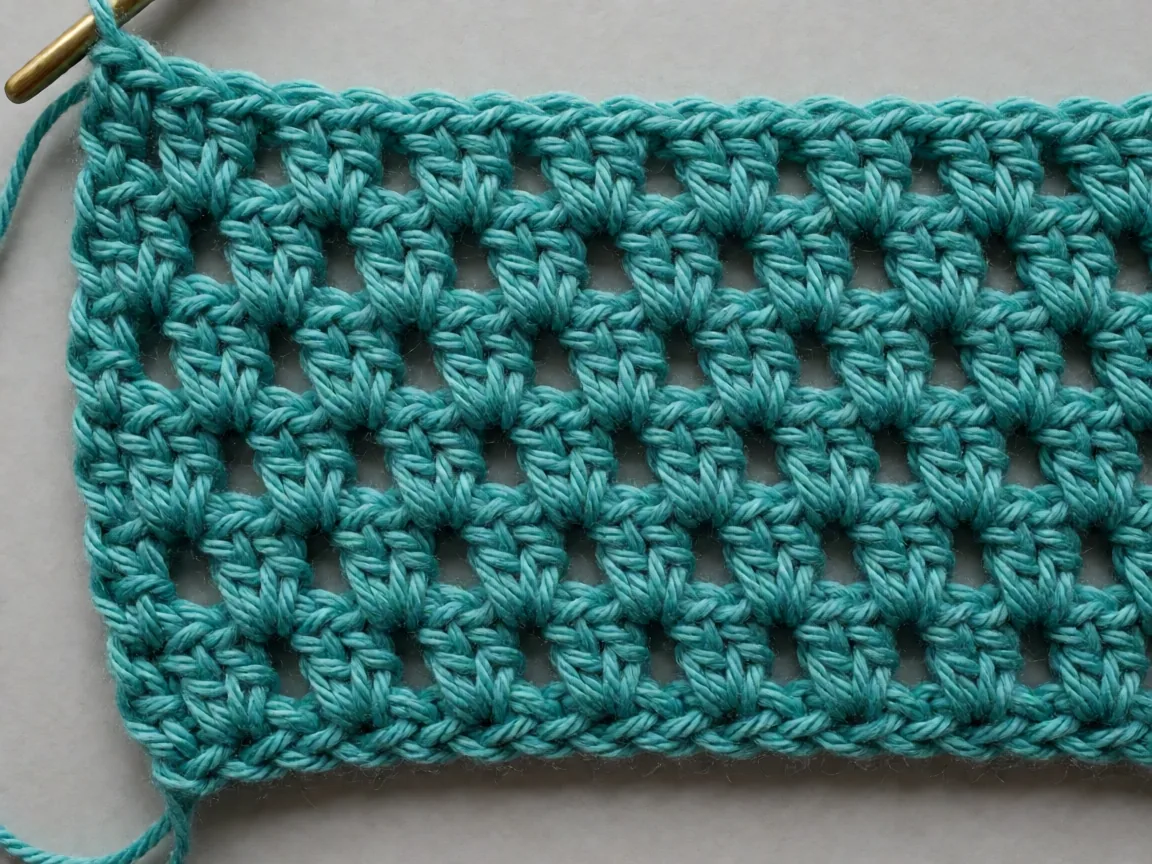
Double crochet is the workhorse. It stands roughly three times the height of single crochet, it covers ground faster than any other everyday stitch, and most patterns you will ever pick up are built from it.
The reason it feels harder than single crochet is not the stitch itself — it is the five steps where single crochet has four, and the fact that you yarn over at the start. Once the opening yarn over becomes automatic, double crochet is one of the easier stitches to work quickly.
Double crochet in five steps
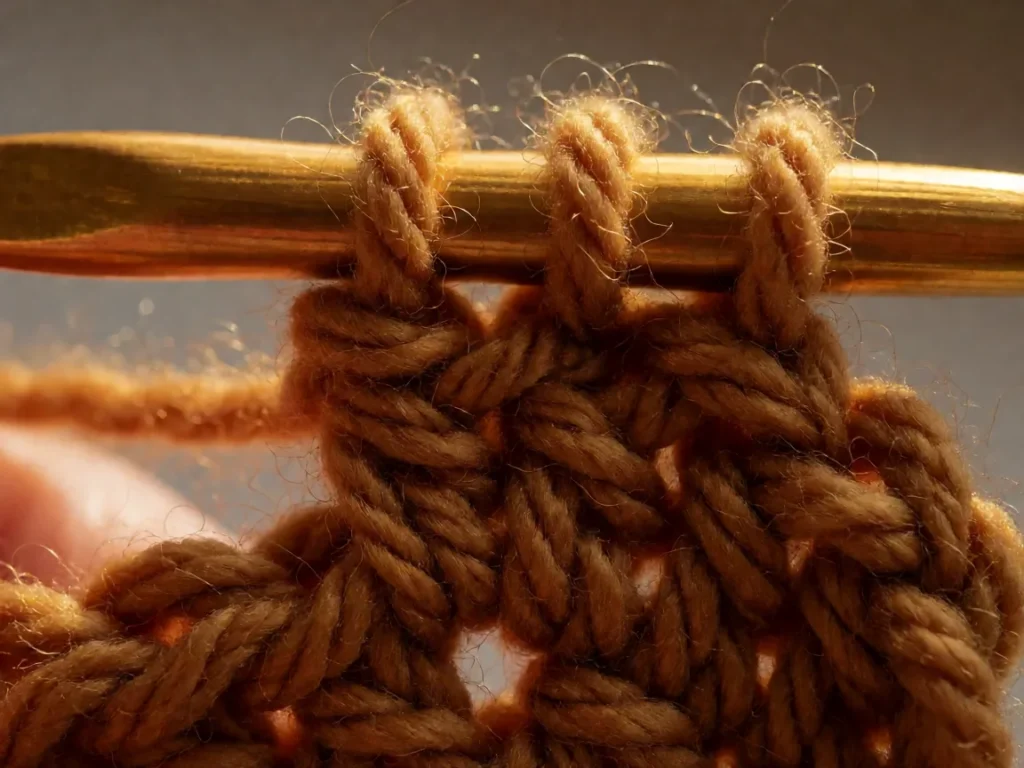
- Yarn over. Wrap the yarn over the hook before you go anywhere near the fabric. This is what makes the stitch tall.
- Insert the hook. Push it through the stitch or space, front to back, catching both loops if it is a stitch.
- Yarn over and pull up a loop. You now have three loops on the hook.
- Yarn over, pull through two loops. Two loops left on the hook.
- Yarn over, pull through the last two loops. One loop left. That is a double crochet.
Note the two yarn overs that finish the stitch. They are what gives double crochet its height, and they are the reason it works up faster than single crochet — you cover three times the vertical distance per stitch.
The chain three turn
At the end of a row, chain three and turn. Those three chains stand in for the height of the stitches you just made, and the stitch directly beneath the third chain is the one you work the first double crochet into. Not the fourth stitch, not the chain itself — the stitch under the third chain.
That single detail is where most beginners lose a stitch. Count out loud once and it stops being a problem: chain three, the third chain sits on top of the stitch you want, work into that stitch.
Where the extra loops come from
Follow the loop count and the stitch makes sense: after step three you have three loops, and you remove them two at a time, twice. Half double crochet is the same idea with only one loop removed after the pull-up, which is why it sits between the two.
Single crochet pulls through both loops in one go; double crochet pulls through two, then two again. Once you can count the loops on the hook, you never have to memorise the steps — you just keep pulling through until one loop is left.
Working in a round
Chain three to rise, work a double crochet into the same stitch you started in, then around. Join to the first stitch with a slip stitch. Double crochet rounds eat more yarn than single crochet rounds, so if you are switching between them mid-project, check that your stitch count still divides evenly into the round.
Tension and the fabric it makes
Double crochet shows tension more honestly than single crochet because the stitch is open — gaps are visible. Loose double crochet leaves holes you can see daylight through; tight double crochet makes a stiff fabric that curls. Both are correct as long as the stitch count matches and the fabric lies flat when you finish.
Because the stitch is taller, there is more opportunity for the yarn over at the start to slip off the hook. If your first double crochets come out shorter than the rest, that is why — check that the yarn over actually made it onto the hook before you insert.
What the numbers actually look like
Worsted-weight yarn worked in double crochet on a 5.5 mm hook commonly lands near 14 stitches and 12 rows per 10 cm. Treat that as a landmark rather than a rule — yarn brand, hook brand and your own tension all move it. The number that matters is the one you measure yourself, which is why gauge gets checked before the first row of any project.
Yarn weight is the other half of the equation. The Craft Yarn Council yarn weight scale runs from lace through to super bulky, and the same 5.5 mm hook makes a completely different fabric at each end of it. A stitch count means nothing on its own; it means something next to a weight and a hook size.
Variations worth knowing
- dc2tog — work the double crochet across three loops instead of two at the first pull-through. Turns two stitches into one.
- dc inc — work two double crochets into the same stitch. Turns one into two.
- dc blo — insert under the back loop only, leaving the front loop as a visible ridge.
- dc around a post — the post stitch, the building block of waffle and basketweave.
Common mistakes
- Forgetting the opening yarn over. The first double crochet of every stitch comes out short and uneven.
- Working into the fourth stitch after the turn. Work into the stitch under the third chain.
- Pulling through all three loops at once. Two, then two. All three at once is a cluster, not a double crochet.
- Letting the yarn over slip off. Keep your thumb on the yarn as you insert the hook.
Next steps
With single crochet and double crochet both comfortable, you can read the majority of published patterns. From there, check your gauge so the fabric matches what the designer intended, and learn to read the abbreviations in our crochet stitch glossary that patterns assume you already know.
Frequently asked questions
How many chains do I turn with between double crochet rows?
Three. Chain three, turn, then work the first double crochet into the stitch sitting directly under the third chain — not the fourth stitch along the row, and not into the chain itself.
Why are my first double crochets shorter than the ones after them?
The opening yarn over is sliding off the hook before you insert it. Keep your thumb against the yarn as you go in and check that the wrap actually landed on the shaft. A short stitch at the very start of every row, with normal stitches after it, is the clearest sign this is what is happening.
Can I swap double crochet for another stitch?
Not one for one. Double crochet stands about three times the height of single crochet and eats noticeably more yarn per row, so a substitution changes both the finished size and the drape. The abbreviations are standardised, and the Craft Yarn Council crochet abbreviations list is worth checking before you swap anything — it is the reference most published patterns assume you can read.
How do I begin a double crochet round?
Chain three to rise, work one double crochet into the same stitch you started in so the round has no gap, carry on around, then join to the first stitch with a slip stitch. Keep an eye on the count as you go — a round that does not divide evenly is the usual reason a circle ends up with a visible wobble.
Still losing count somewhere? Leave a comment naming the step that trips you up and I will write that one up in full.