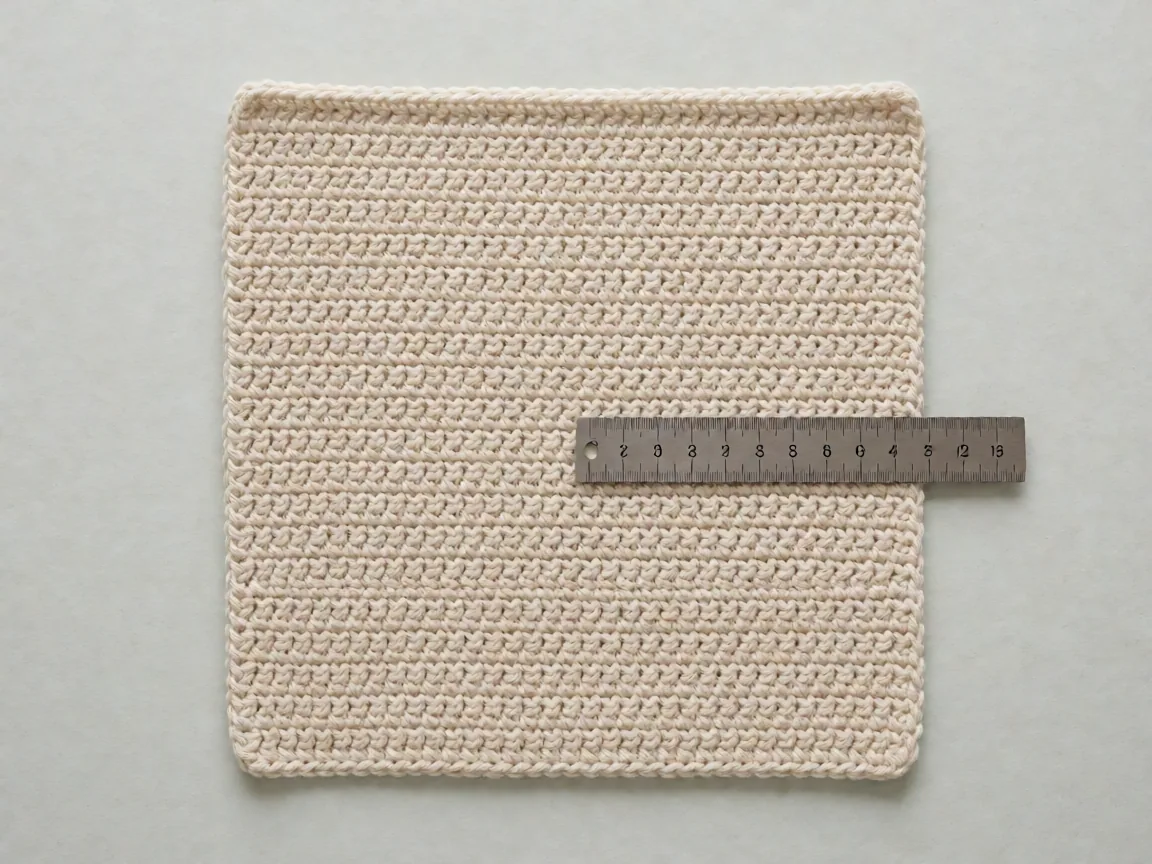
Gauge is the least enjoyable step in a crochet project and the one that saves you the most. It takes ten minutes with a tape measure. Skipping it costs you a finished-size blanket that is two widths too narrow, or a hat that fits nobody in your family.
Here is the honest version: you are not doing this because the pattern says so. You are doing it because you already know your tension is different from the designer’s, and you would rather find that out on a swatch than on row forty.
What gauge actually measures
Gauge is how many stitches and rows you fit into a fixed measurement — usually 10cm or 4 inches. That is all. A pattern states a gauge like “16 sts x 14 rows = 10cm in 4 ply dk with a 3.5mm hook”, and that line is a promise about your hands, not about the yarn.
Two crocheters using the same yarn and hook will produce different gauges. Crochet tightly and you get more stitches in 10cm. Crochet loosely and you get fewer. Both are correct; neither matches the pattern unless the pattern says so.
Making the swatch
Work in the stitch the pattern uses. If the pattern is in single crochet, a double crochet swatch tells you nothing useful about the actual project.
- Chain 25 to 35 stitches — more than you think you need, because you are measuring the middle and edges lie.
- Work the pattern stitch for at least 15 rows.
- Work the turning chain at the end of each row, exactly as the pattern specifies.
- Do not fasten off, do not block, do not stretch it flat. Measure it exactly as it lies.
That last point is the one people skip. Blocking changes the measurement — often by several percent — and if you block before measuring you are measuring a different object than the one you will be working.
Measuring it
Lay the swatch on a hard, flat surface. Smooth it out gently with your hands only — no ruler pressing, no stretching. Measure across the widest part of the middle section, in centimetres, and count the stitches within that exact width.
For rows, measure from the top of the first row to the top of the last complete row. Counting from row to row by eye is where the error creeps in.
Write both numbers down, including the hook size and the yarn. A gauge without its hook size is not a measurement, it is a rumour.
When your gauge is too tight
You are getting fewer stitches in 10cm than the pattern wants. Three options, in order of preference:
- Go up a hook size. The reliable fix. A half-millimetre change often resolves a full stitch count.
- Work more loosely. Change your tension rather than the tool — hold the fabric in your off hand and let the work pull through.
- Change stitch pattern. Sometimes a pattern worked in half double instead of single gives the height you need.
Going up a hook size is not cheating. It is the intended mechanism. Every pattern says “use a hook size to obtain the gauge”, and the fabric changes accordingly — a loose crocheter in a double crochet fabric will get a softer, drapey result, which may be exactly what you want anyway.
When your gauge is too loose
More stitches in 10cm than the pattern wants. The mirror image: go down a hook size, or tighten your tension. Going down can make fabric stiff on some yarns, so if the yarn is already firm, adjust tension before you adjust the hook.
Adapting a pattern instead of abandoning it
Here is the arithmetic, and it is genuinely simple. If you measure 14 stitches in 10cm and the pattern calls for 16, then your stitch is larger than the designer’s by a factor of 16/14 — call it 1.14. A finished width of 30cm needs 14 × 3 = 42 stitches instead of 16 × 3 = 48.
Multiply every count in the pattern — every stitch number, every row number — by that factor, then add or subtract one for rounding and cast on the adjusted number instead.
Three cautions before you do this. First, textured and lace stitches have no predictable relationship to gauge; only work the arithmetic on standard stitches. Second, changing the stitch count changes the row count, which changes everything above it, so work from the bottom up. Third, if you are adjusting by more than about 15 per cent, adjust the hook size first and re-measure. Large arithmetic corrections are where mistakes hide.
When to stop measuring
Once. If the swatch matches, stop. If it is off by a hook size or two, make the hook change and stop. The obsessive re-measuring spiral — adjusting tension, re-swatching, adjusting again — produces swatches you have manipulated into matching rather than learning anything about your own hands.
The exception is projects where fit matters to someone: a hat with a specific head size, a fitted sweater, anything with a garment block. Those get a second swatch in the actual yarn, not a different yarn in the same weight. Yarn weight is a category, not a promise.
Frequently asked questions
Why does my gauge change after I wash the swatch?
Because the swatch was not finished when you measured it. Wool and cotton behave very differently in water, and many yarns relax or tighten as their fibres take on moisture. Measure dry, then wash and dry the swatch exactly as the pattern tells you to, and measure again. The second number is the one that predicts your finished fabric.
Do I have to swatch in the exact stitch from the pattern?
Work the stitch the pattern is built on. A swatch in single crochet tells you nothing about a fabric made in double crochet, and a colourwork or cable swatch tells you even less about a simple textured row. If you are unsure which stitch dominates the piece, that is the pattern to read again before you commit yarn to it.
How do I know my swatch is the right size to measure?
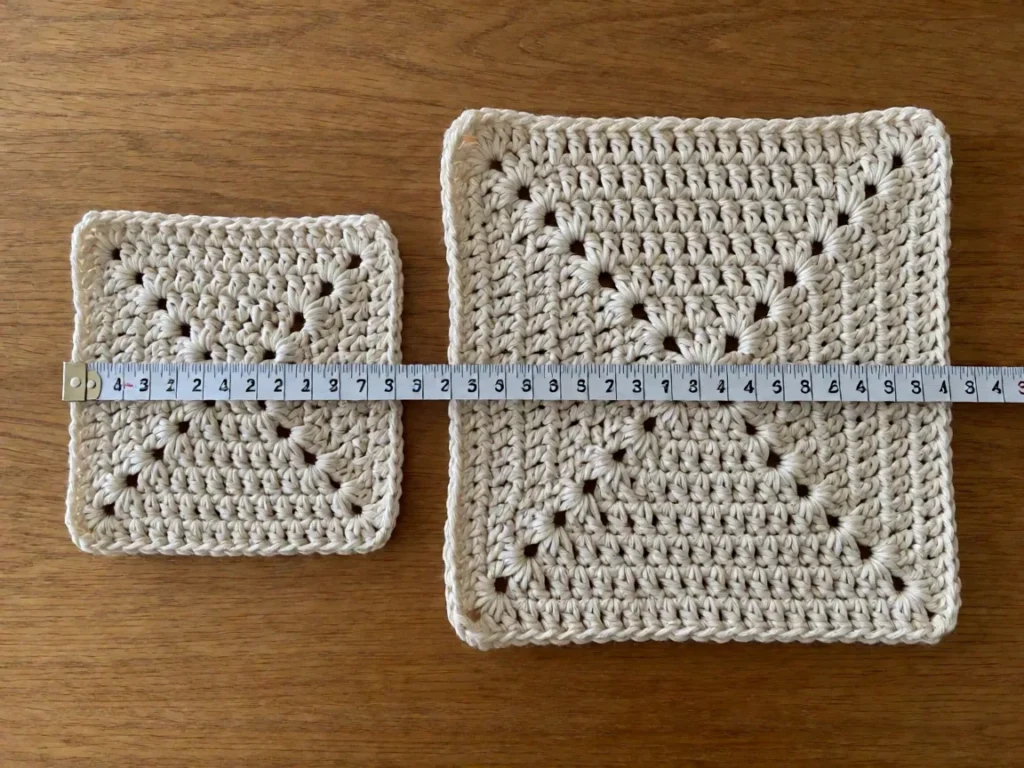
Anything roughly 15 cm square works. Too small and the edge stitches distort every row you count; too large and you have swatched a project instead of a sample. A 15 cm square worked in the pattern stitch, washed as directed, and measured in the middle is the standard for a reason.
Hook sizes are not interchangeable across brands, which is worth remembering when a pattern asks for 4.0 mm and your set gives you something looser. The Craft Yarn Council hooks and needles standard lists the metric sizes those markings refer to.
Next steps
With gauge understood, the remaining beginner skills are pattern literacy and materials. Read how to read a crochet pattern so the gauge line makes sense in context, and use our yarn guide to pick a weight that pairs with the stitch you want to use. Stitches themselves are defined in the crochet stitch glossary.
Swatched something that will not budge to the right gauge? Tell me the yarn, the hook size and the pattern stitch, and I will tell you whether to change the hook or the yarn.