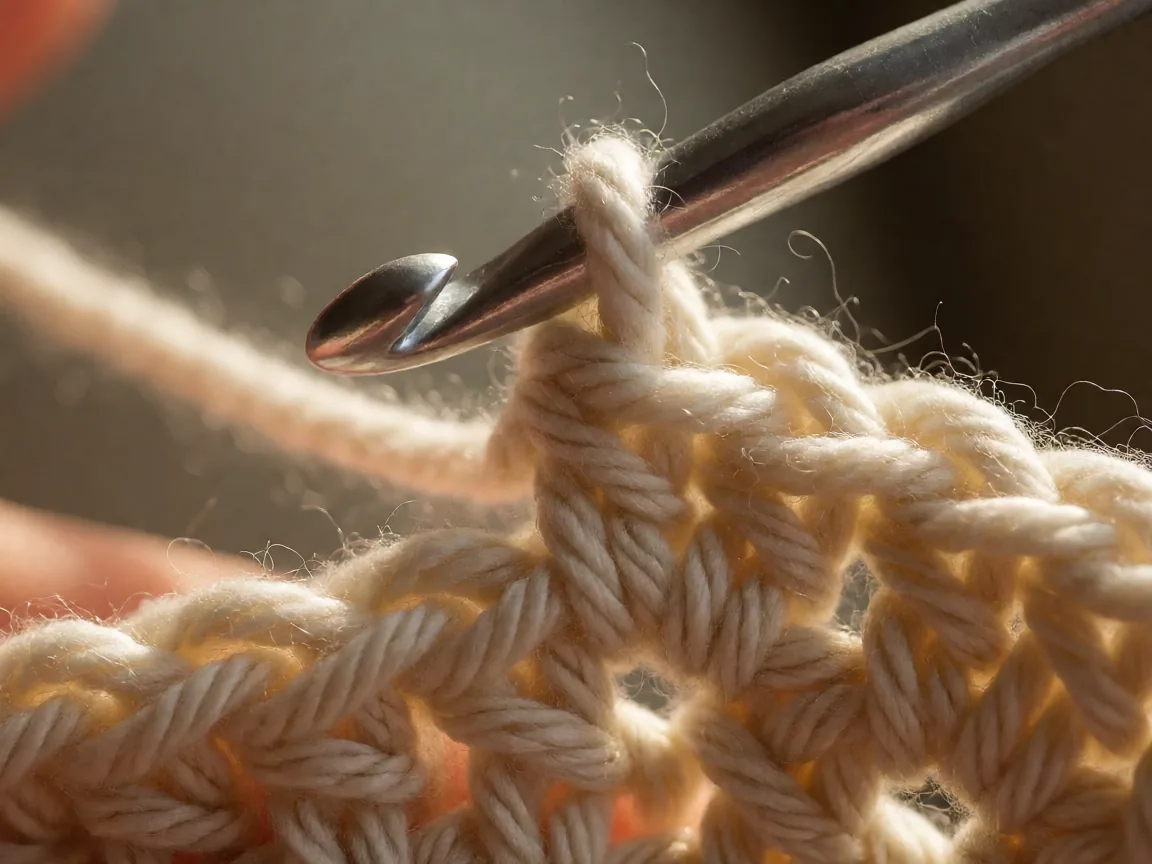
Single crochet is the stitch you will use more than any other. It is the shortest stitch that produces fabric, it appears in roughly every pattern ever published, and once you can do it smoothly you have unlocked the whole craft.
It is also the first stitch where beginners hit the wall — specifically the bit where you pull yarn through two loops at once and it comes apart. That moment is the whole trick, and this guide exists to get you past it.
Single crochet in four steps
- Insert the hook. Push the hook through the stitch or space, front to back, catching both loops if it is a stitch.
- Yarn over and pull up a loop. Catch the yarn and pull it back through the fabric. You now have two loops on the hook.
- Yarn over, pull through both loops. Catch the yarn again and pull it through the two loops together in one motion. One loop left on the hook.
- Repeat. This is single crochet. There is no final step.
Four steps, and the third one is the entire difficulty. Everything else is just the motion you already have from slip stitch.
Why step three catches people
Pulling through two loops at once feels wrong until it does not. The instinct is to pull each loop through separately, which produces a gap and a loose stitch that unravels the row below. The trick is to catch the yarn with the hook tip before you rotate, and to pull through both loops in a single continuous motion without letting go of the loop already on the hook.
Practise on a foundation chain of about fifteen stitches. Once you can get ten single crochets without the row twisting or splitting, the stitch has landed.
Working in a row
At the end of a row, chain one, turn the work, skip the turning chain, and single crochet into the second stitch of the previous row. That “skip the turning chain” instruction is not optional — the chain is not a stitch, and crocheting into it makes a ragged edge.
The second stitch can feel tight at first. That is normal; it opens up as you work and matches the chain height.
Working in a round
To begin a round, make a chain one, then single crochet into the same stitch you started in. To join the round, slip stitch into the first stitch. Mark the first stitch with a stitch marker every round — it is the difference between a flat circle and a cone.
If you are new to rounds, this is where the glossary entry on magic loop saves you from a permanent hole in the middle.
Tension and the fabric it makes
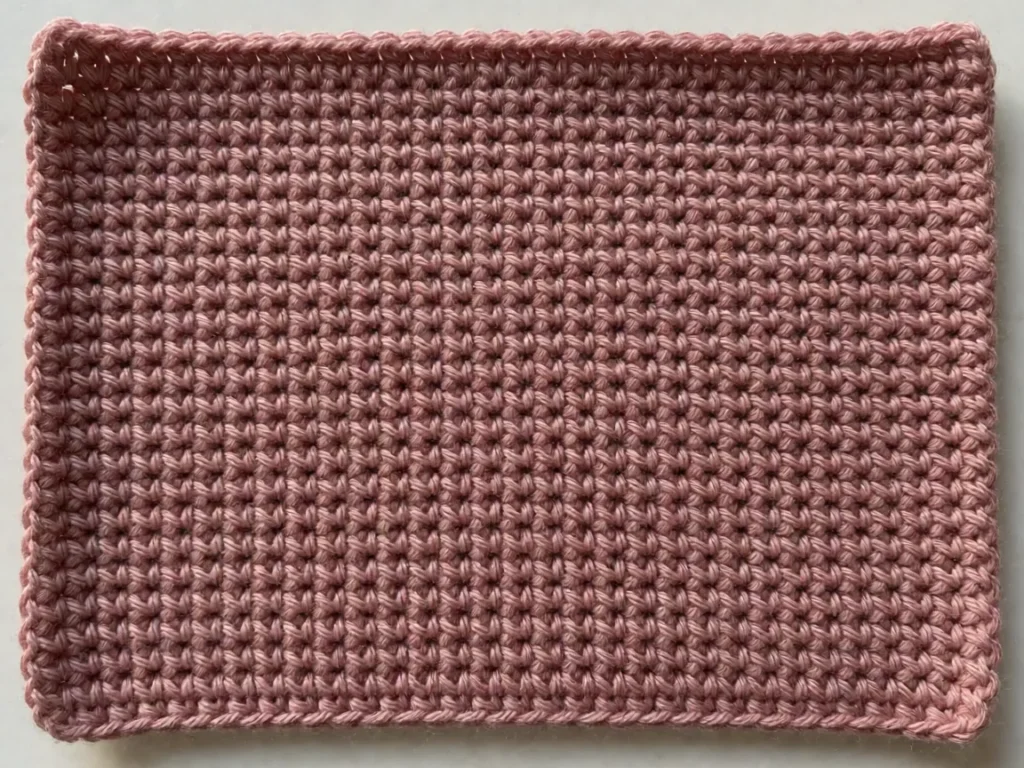
The number of stitches is not the only thing that determines whether a swatch is correct. Tension is. Tight single crochet produces a stiff, small fabric that curls at the edges; loose single crochet produces a gaping, floppy fabric. Both count the right number of stitches and both are technically correct.
Two habits keep tension consistent. Move the fabric, not the hook, and keep the working yarn in front of the work rather than reaching over it. If your rows are not lining up — the fabric narrows or flares — tension is the cause, not your stitch count.
Variations worth knowing
- sc blo — insert under the back loop only, leaving a ridge. One row of this is ribbing.
- sc2tog — insert through two stitches and complete as one. Turns two stitches into one.
- sc inc — work two single crochets into the same stitch. Turns one stitch into two.
- sc in the back loop behind — an invisible decrease, worked with the stitch behind the current one.
Common mistakes
- Pulling the loop through the fabric too short. Pull up a full loop so the hook has something to grab.
- Working into the turning chain. Skip it. This is the most common reason edges look uneven.
- Dropping the loop before the yarn over. Keep the loop on the hook through step three.
- Rushing. Single crochet is not a fast stitch. Speed comes after consistency, and consistency comes before speed.
Next steps
Once single crochet is automatic, the natural progression is double crochet — taller, faster, and the other half of the stitches you will see in patterns. Both are defined in our crochet stitch glossary alongside the shaping and texture stitches that build on them.
Frequently asked questions
Why does single crochet feel tighter than double crochet?
Because it does less work per stitch. Double crochet starts with a yarn-over, which adds height to the row and gives the fabric room to breathe. Single crochet goes straight into the stitch with no wrap, so the same number of stitches packs into a narrower band. The result is a dense, sturdy fabric that holds shape well and shows stitch definition clearly, which is why so many beginners end up with tighter tension than the pattern designer intended.
How tight is tight enough?
Measure it rather than judging by feel. Work a row of 20 single crochet in the pattern stitch, lay it flat without stretching, and count how many stitches fit inside 10 cm. In DK or light weight on a 4.0 mm hook, published patterns usually land around 16 to 17 stitches per 10 cm. If you are getting 14, your tension is tight; if you are getting 20, it is loose. Whichever number you get, that is the number your swatch has to report.
Why does my stitch count drift by one at the end of each row?
Almost always the turning chain. Many patterns intend the final stitch of a row to double as the turning chain, so a row that reads 18 stitches is worked as 17 single crochet plus the chain. Once the last stitch is treated that way, the count stops wandering. Check the pattern notes before deciding which interpretation it wants.
Patterns abbreviate this stitch sc in US terminology and sc for slip stitch in UK terminology, so check which convention the pattern declares before you start. The Craft Yarn Council crochet abbreviations standard is the list publishers work to.