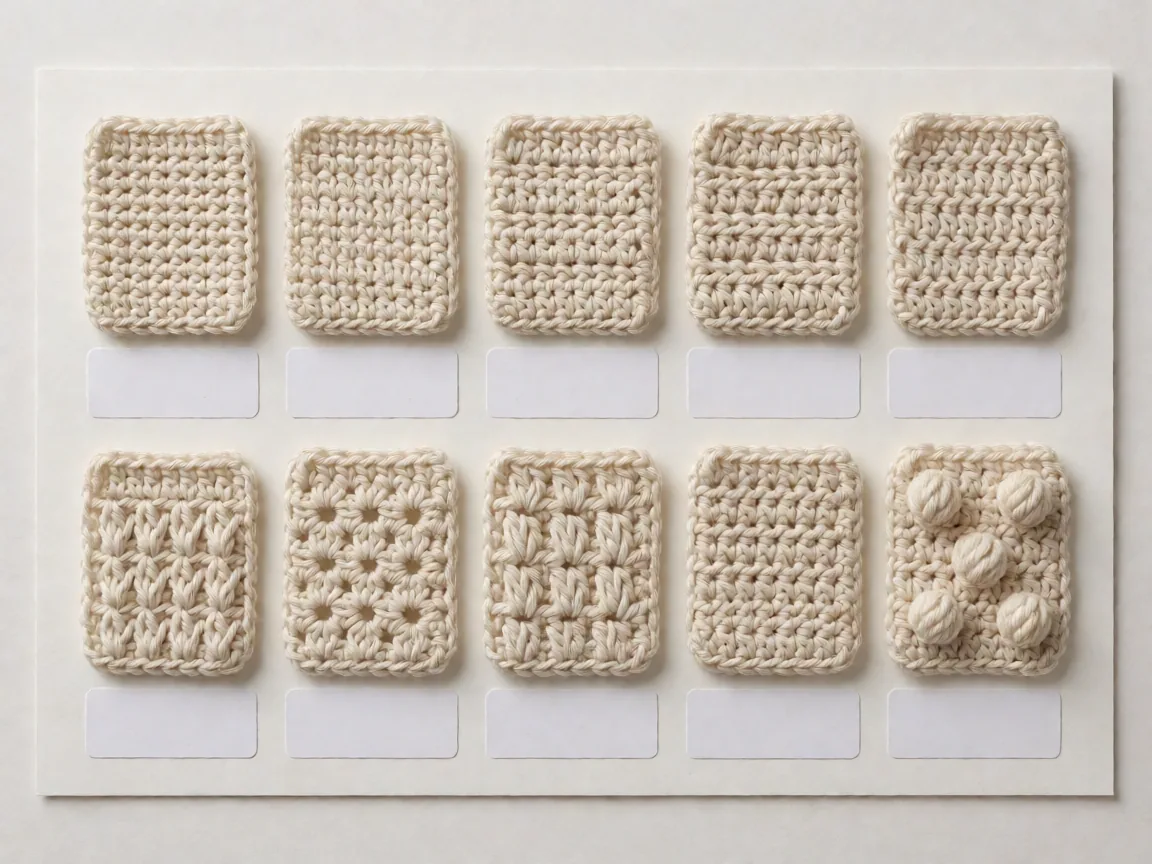
Here is the thing about crochet patterns: they are written in an abbreviation nobody teaches you. A pattern will say “ch 1, sc in each st across, ch 1, turn” and expect you to know that means chain one, work single crochet into every stitch, chain one, turn the work around. That is a language, and nobody hands you the dictionary.
This page is the dictionary. Thirty stitches, grouped into four families, with plain-language definitions for each. It is deliberately organised by family rather than alphabetically, because the families tell you something useful: if you can work the basic family, you can read almost any pattern, because patterns are mostly basic stitches plus occasional shaping.
If you are completely new, read the four families top to bottom in order and make the stitches as you go. If you are stuck on one specific term, jump to it and read the whole family around it.
Why abbreviations exist
Crochet stitches are tall. A double crochet is about three times the height of a single crochet, and a row of them takes up real space on the page. Writing out full names would make patterns three times longer and impossible to follow across a page. So the industry agreed on two-character codes.
The convention is: the letter is the stitch name, the number is how many you do in the same place. That single rule explains most of what you will meet.
- sc — single crochet, one stitch.
- sc2tog — single crochet two together, so two stitches become one.
- dc2tog — double crochet two together, two stitches become one.
- [sc, sc, sc] — the same stitch worked three times in one place.
Suffixes carry the rest of the meaning. tog means together (a decrease). inc means increase. blo means back loop only. fo means front loop only. Once you know the suffixes, a new stitch abbreviation is usually guessable.
Family 1 — Foundation stitches
These build the base row. You cannot crochet anything without them.
1. ch — chain
A foundation loop: yarn over, pull the working yarn through the loop on your hook, repeat. Chains are the starting point for nearly every other stitch and also serve as turning chains between rows. A slip stitch is a chain worked directly into a stitch rather than into the chain space.
2. sl st or ss — slip stitch
The shortest stitch there is. Insert the hook, pull yarn through both loops, pull through the loop on your hook — done. It joins stitches and it works around edges. It produces no fabric of its own. Full walkthrough in our slip stitch guide.
3. magic loop or magic ring — adjustable start
Not a stitch but a technique: wrap the yarn around your finger, cross it, work into the loop, then pull the tail to close the gap. Leaves no hole at the centre of a round. Essential for amigurumi.
Family 2 — The basic stitches
These produce fabric. Height increases with each one, and every pattern you will ever make is mostly these four.
4. sc — single crochet
Insert, pull up a loop, yarn over, pull through both loops. The shortest stitch that makes fabric, and the first one to learn. Full walkthrough in our single crochet guide.
5. hdc — half double crochet
Like single crochet but yarn over first, so it is taller. The extra step makes it faster to cover ground and it makes dense, firm fabric. Very popular in modern blankets.
6. dc — double crochet
Yarn over, insert, pull up a loop, yarn over and pull through two loops, yarn over and pull through the last two. Three times the height of single crochet. Full walkthrough in our double crochet guide.
7. tr — treble crochet
Yarn over twice, then work like a double crochet but pull through two loops three times. The tallest stitch in regular use, which is why open lace and shawls use it.
8. htr — half treble crochet
Between half double and treble. Uncommon, and worth knowing so you do not think a pattern has a typo when it says hdc where you expected htr.
9. sc2tog — single crochet decrease
Single crochet two together. Insert your hook through two stitches, pull up a loop, yarn over and pull through all three loops at once. Two stitches become one. This is how fabric narrows.
10. dc2tog — double crochet decrease
Yarn over, insert through two stitches, pull up a loop, and complete the double crochet across all three loops. Same idea, taller result.
Family 3 — Texture stitches
These are the basic stitches worked differently — usually into the back loop only, or into the stitch itself rather than its top loops.
11. sc blo or scBLO — single crochet back loop only
Insert your hook under the back loop only, not both loops. Leaves the front loop as a visible ridge. A single row of blo is ribbing. Adding this to a familiar stitch makes it look like a different stitch entirely.
12. sc flo — single crochet front loop only
The mirror of blo. Leaves the back loop visible as a ridge.
13. hdc blo — half double back loop only
Back loop only, in half double crochet. Deeper ribbing than single crochet blo, because the stitch is taller.
14. dc blo — double crochet back loop only
Textured, and it creates visible gaps in the row below. Common in winter blankets.
15. pc or sl st over — post stitch
Worked around the post of a stitch from the row below rather than into its top. Produces a raised column — this is what waffle and basketweave stitches are built from.
Family 4 — Decorative and specialty stitches
Used for texture, edging and joining. You do not need these early, but you will meet them.
16. picot
Chain, slip stitch into the first chain, repeat. Worked at the edge of a row as a tiny decorative loop. The detail on most lace edgings.
17. bobble — puff stitch
Several stitches worked into one place to create a raised bump, then closed. Puff stitch, bobble and popcorn are variations of the same idea.
18. cluster — granny cluster
Usually three double crochets worked into the same space. The basic unit of a granny square, and therefore the basis of most granny square blankets.
19. shell — fan stitch
A wider version of a cluster, usually five stitches in one space, fanning out into a scallop. Common in shell borders.
20. crab stitch — reverse single crochet
Worked left to right instead of right to left, inserting the hook under the stitch from two rows below. Produces a firm, corded edging that is far more hard-wearing than slip stitch.
21. sl st join — invisible join
A slip stitch worked into both pieces at once. Seams edges neatly. The alternative is the whip stitch, which is invisible from the front.
22. v-stitch
Chain, one stitch, chain, all worked into the same space. Creates a pointed open mesh. The base of many lace and shawl patterns.
23. sc2tog behind — invisible decrease
A decrease worked with the stitch behind the current one, so the decrease does not leave a visible gap. Used wherever decreases would otherwise show.
24. yarn over or yo — yo
Not a stitch: wrap the yarn over your hook without pulling it through. Part of the double and treble crochet. Yarn over twice means the next stitch will be taller.
25. beg — beginning of row
The turning chain. Three chains to begin a double crochet row, two for half double, one for single. Counted as stitches in some patterns and not in others — check before you start.
26. sk — skip
Do not work into a stitch. “sc in next st, sk 1 st” means work one stitch, leave the next alone, continue.
27. rep from * — repeat
Return to the asterisk and work the sequence again. The workhorse of every border and edging pattern.
28. ( ) or [ ] — group
Brackets mean “work everything inside as one unit”. [dc, ch 1, dc] means those three stitches go in the same space.
29. st inc — single crochet increase
Work two single crochet into the same stitch. One becomes two. The inverse of a decrease, and the other half of shaping.
30. fasten off
Not a stitch, but it ends every project: cut the yarn, pull it through the last loop, pull tight. Cut too short and the end unravels — leave 15cm at minimum.
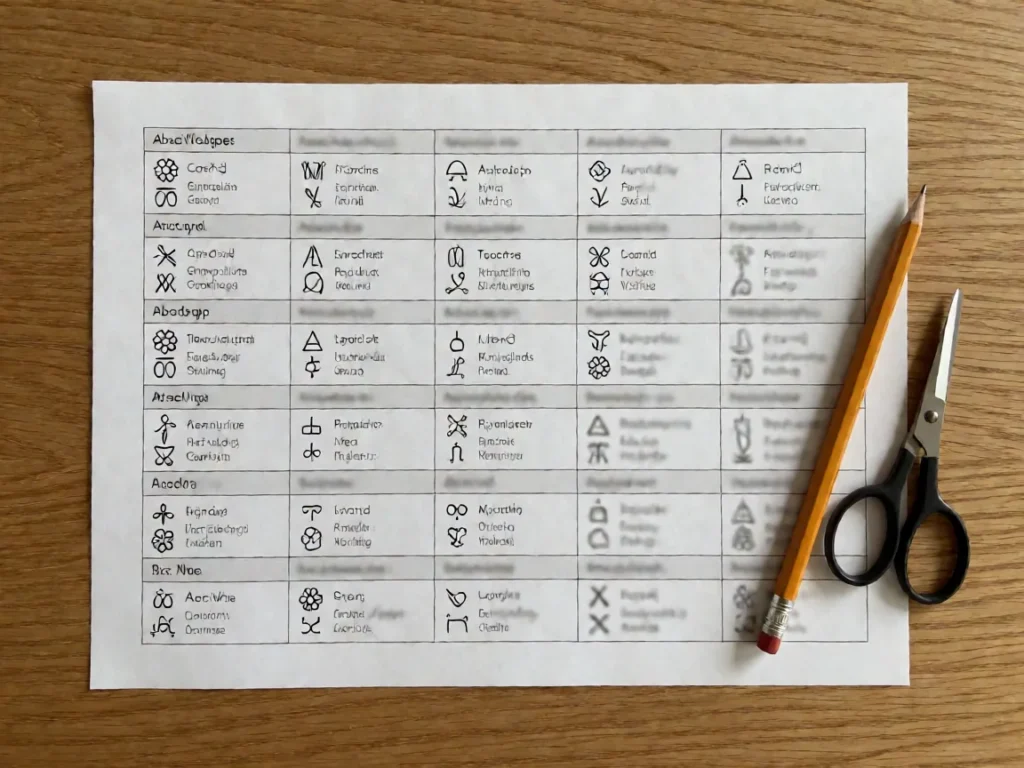
US versus UK terminology
British patterns use different names for the same stitches, which trips up anyone reading an older or British pattern:
| US term | UK term |
|---|---|
| single crochet (sc) | double crochet (dc) |
| double crochet (dc) | treble crochet (tr) |
| treble crochet (tr) | triple treble (trtr) |
| half double (hdc) | half treble (htr) |
| slip stitch (ss) | slip stitch (ss) |
Abbreviations are the reliable signal. UK patterns abbreviate single crochet as sc and double crochet as dc too, so if you are working from a UK pattern, assume its dc means tall stitch.
How to use this glossary
Learn families 1 and 2 properly and you can read roughly ninety percent of published patterns. Family 3 is what turns flat work into texture, and it is worth learning once you are comfortable. Family 4 is reference material — look it up when you meet it rather than learning it in advance.
For the full mechanics rather than definitions, start with our step-by-step guides: slip stitch, then single crochet, then double crochet. Once those three are automatic, the rest of this page is reference rather than instruction.
Frequently asked questions
Why does sc mean two different things?
In US terminology sc is single crochet, a tall-ish fabric stitch. In UK terminology sc is the slip stitch, which is barely a stitch at all — it just joins. The ambiguity is the single most common reason a UK pattern produces a completely different object to the one pictured. Check which convention a pattern declares before you assume.
How do I tell which convention a pattern uses?
Look at the abbreviations key and the gauge line together. A line like 16 sts x 14 rows = 10 cm with a 4.0 mm hook tells you both the tension and the terminology: a pattern stating 16 stitches across 10 cm in medium-weight yarn is using the US system, where those stitches are single crochet. Turn the page and the numbers will not line up if you have guessed wrong.
Do I need to memorise all of these?
No. Learn the four structural stitches properly — chain, slip stitch, single crochet, double crochet — and treat everything else as lookup. Those four cover the large majority of published patterns. The shaping and texture stitches in this glossary are here so that when you meet one in a pattern, you can identify it and find it in under a minute rather than abandoning the project.
When you do need the authoritative list rather than a summary, the Craft Yarn Council crochet abbreviations standard is the reference that publishers and manufacturers work to, and it is worth bookmarking.
Met an abbreviation on this page you think we have got wrong? Leave a comment with the term and I will check it against the standard.