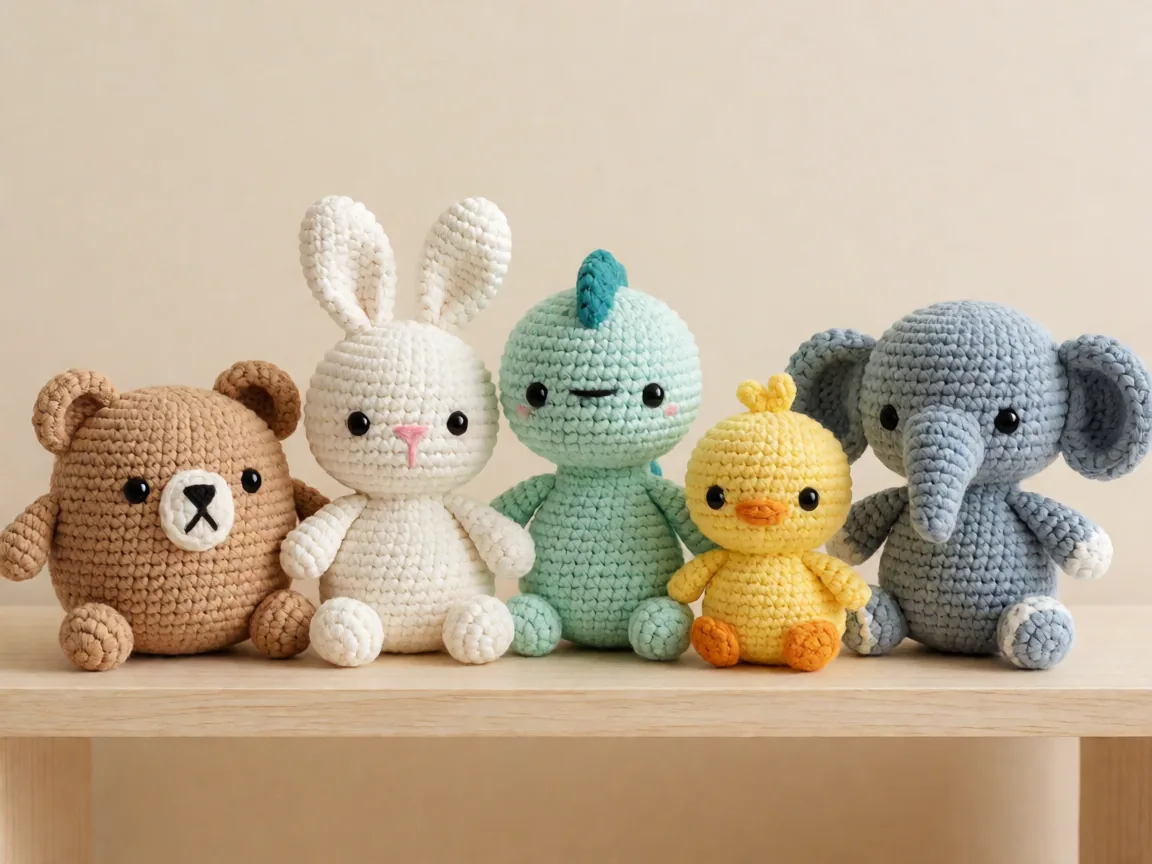
There is a specific reason beginner crocheters gravitate to amigurumi, and it is not that the patterns are easy. It is that they are short. A single crochet round takes forty seconds. There is no back to work, no second sleeve, no row you have to count three times. You finish something in an evening, and finishing something is what makes you keep going.
These fifteen patterns are sorted by stitch count and shaping complexity, not by how popular they are on social media. Everything in the first five uses single crochet and one decrease. Nothing here requires you to work in the round with a double crochet spiral, embroidery, or plastic safety eyes — all of which are excellent but all of which are second-project skills.
If you have not worked single crochet in the round yet, make numbers 1 and 2 below first — they need no shaping at all. And if you have never closed a piece, start at number one on this list rather than jumping to the llama. If you want a flat warm-up project first, the beginner pattern roundup is the better starting line.
Why amigurumi is the right first 3D project
Amigurumi is Japanese crochet worked in continuous spirals with a single stitch and frequent decreases. Three properties make it ideal for a beginner:
- It grows one round at a time. You can see the shape forming and stop whenever you like. A half-finished piece is still a recognizable object.
- Decreases do the shaping. If you can make two stitches into one, you can make almost anything in this list.
- Failure is cheap. A failed round costs three minutes of unpicking. There is no set-in sleeve to unpick for six hours.
Tension notes before you buy yarn
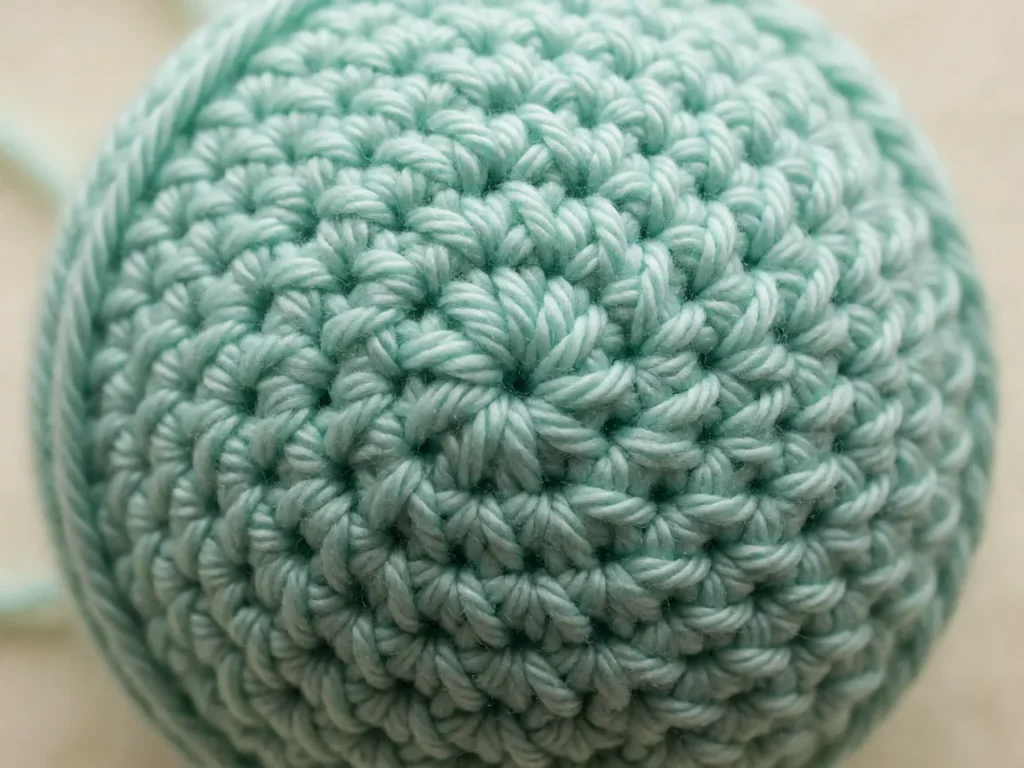
Amigurumi demands tight stitching. This is the single biggest reason beginner amigurumi comes out lumpy and holey, so read this before you start:
- Use a hook one size smaller than the label suggests. Amigurumi is worked tighter than garments. A 3.5mm hook with DK yarn usually gives a firm, hole-free surface where the label hook leaves gaps.
- Stuff as you go, lightly. Overstuffed pieces bulge between the decreases and distort the shape. Polyester stuffing packs tighter than fibrefill; use less than you think.
- If pieces curve or cone upward, your tension is too loose. This is the classic beginner error and it is not fatal — go down a hook size rather than pulling harder, which tightens your hands and creates hand strain.
- Measure your gauge on the round. Circle gauge does not behave like flat gauge, which is why our gauge guide explains why flat swatches mislead amigurumi.
The 15 patterns
1. Jellyfish with Tentacles — 1 stitch type
Vocabulary: chain, single crochet, slip stitch.
Yarn: DK cotton or acrylic.
Time: 90 minutes including tentacles.
A dome worked in plain single crochet rounds, then chain tentacles left loose. There is no decrease to learn and nothing to shape. The tentacles hide every imperfection in the dome, which makes this the right very first piece.
2. Round Puffball — 1 stitch type
Vocabulary: chain, single crochet, slip stitch.
Yarn: Any weight, scrap yarn is fine.
Time: 20 minutes.
Twenty minutes, four decreasing rounds, done. If you want to learn the decrease mechanic without committing to an object that has to look like something, make two of these.
3. Octopus with Curling Arms — 1 stitch type
Vocabulary: chain, single crochet, single crochet decrease.
Yarn: DK acrylic.
Time: 2 hours.
The same dome as the jellyfish, plus eight chain arms. Arms are the easiest possible place to hide loose tension because they hang rather than stand.
4. Seahorse — 2 stitch types
Vocabulary: chain, single crochet, single crochet decrease, single crochet increase.
Yarn: DK cotton.
Time: 2.5 hours.
Your first use of increase — one stitch becoming two. A seahorse is mostly increases through the body and a snout of tight decreases at the head. Simple silhouette, so the shaping is forgiving.
5. Simple Whale — 2 stitch types
Vocabulary: chain, single crochet, single crochet decrease, slip stitch.
Yarn: DK worsted acrylic.
Time: 2 hours.
A whale is an ellipsoid: rounds that increase, rounds that hold, rounds that decrease. It is the purest possible demonstration of how amigurumi shaping works, and it looks convincingly like a whale with no embroidery.
6. Cupcake with Frosting — 2 stitch types
Vocabulary: chain, single crochet, single crochet decrease, colour changes.
Yarn: Two colours, DK.
Time: 2 hours.
The wrapper is a straight cylinder and the frosting is three decrease rounds worked in a second colour. Colour changes are the only new mechanic, and they are trivial: work the last stitch of a round in the new colour.
7. Mini Ghost — 2 stitch types
Vocabulary: chain, single crochet, single crochet decrease.
Yarn: White DK acrylic.
Time: 75 minutes.
A cylinder that flares at the base. The flare is achieved by placing two stitches in every stitch along the final round, which is the easiest possible increase technique.
8. Froggie Pocket Pal — 2 stitch types
Vocabulary: chain, single crochet, single crochet decrease, single crochet increase.
Yarn: DK green acrylic.
Time: 2.5 hours.
Slightly larger, with four limbs worked as separate small pieces and sewn on. This is your first assembly job: four attachments and two eyes. Twenty minutes of finishing on top of ninety minutes of crocheting.
9. Penguin with Beanie — 3 stitch types
Vocabulary: adds half double crochet for the beanie brim.
Yarn: DK black, white and red.
Time: 3 hours.
Three colours and one new stitch. The body and head are one continuous piece, which is the trick that makes it look good. Worth attempting once you have made two of the above without frustration.
10. Snail with Swirl Shell — 3 stitch types
Vocabulary: adds double crochet for the shell spiral.
Yarn: DK in two colours.
Time: 3 hours.
The shell is worked as one continuous spiral of alternating colour rounds rather than as separate stitches, which is what gives it the swirl. It is the first pattern on this list that rewards concentration over speed.
11. Bumblebee Keyring — 3 stitch types
Vocabulary: chain, single crochet, double crochet, decrease, increase.
Yarn: Two colours, DK.
Time: 2.5 hours.
A body, two striped wings in the round, and a keyring through the loop at the top. Small enough to finish quickly, and it is the first pattern here that is designed as an object to carry rather than a toy to display.
12. Sleeping Cat — 4 stitch types
Vocabulary: chain, single crochet, half double crochet, decrease.
Yarn: DK worsted.
Time: 3 hours.
A curled body in half double crochet with a separate head and two front paws. The half double stitch is fatter, which is exactly right for a cat, and it is the stitch that makes 3D pieces look solid rather than lacy.
13. Mushroom with Spots — 4 stitch types
Vocabulary: chain, single crochet, double crochet, decrease, increase.
Yarn: DK in two or three colours.
Time: 3 hours.
A straight cylinder stem and a wide decrease cap. The cap relies on a steep decrease rate, which is where a beginner’s tension is most visible — go down a hook size if the cap domes rather than flattening.
14. Llama with Scarf — 4 stitch types
Vocabulary: chain, single crochet, half double crochet, decrease.
Yarn: DK worsted, plus a scrap of red.
Time: 3.5 hours.
The tallest piece here: a long neck means roughly forty rounds before you shape the head. That length is what makes it a genuine multi-session project, and it is why it is number fourteen rather than number one.
15. Little Bird with Egg — 4 stitch types
Vocabulary: chain, single crochet, double crochet, decrease, increase.
Yarn: DK worsted, plus a scrap of white.
Time: 3.5 hours.
A body in double crochet, two wings, and a separate egg worked to fit inside it. The nesting detail is what sells it. A good final project: no new techniques, but enough shaping to feel like you have arrived.
How to choose
Pick by where you actually are, not by where you want to be in a month:
- Never closed a piece? Numbers 1–3.
- Comfortable with decreases? Numbers 4–8.
- Working in the round confidently? Numbers 9–12.
- Want a real project? Numbers 13–15.
If your instinct is to start at fifteen, start at fifteen. You will learn the missing steps on the way and you will finish something you chose, which matters more than finishing something appropriate.
Once these are behind you, the natural next step is joining motifs into something larger — start with the crochet blanket roundup. And if terms like sc2tog are slowing you down, our stitch meanings glossary covers every abbreviation used on this page.
Frequently asked questions
Why does amigurumi need tighter stitching than a blanket?
Because it is stuffed. A loose amigurumi seam splits open the moment you push polyfill inside it, and a tight seam makes the shape hold. Most amigurumi patterns are worked in the round with a hook one size smaller than you would reach for on your own, and the fabric is meant to look slightly firm rather than drapey.
Do I need a stuffing-free alternative?
Only if the finished piece is for a small child. Stitch amigurumi tightly enough to hold its shape without fibre fill, and check for beads, safety eyes and long limbs — those are the parts that need removing, not the sewing. Everything on this page works as a sewn shape on its own.
How do I keep the piece from curling as I work it?
Work in the round without slipping stitches, mark the first stitch of each round, and count back to it rather than eyeballing the join. Amigurumi spirals for a long time — dozens of rounds — so a count you trust early is worth more than a correct-looking join that drifts.
The weight classes recommended here follow the Craft Yarn Council standard yarn weight system, which is the scale most published patterns use when they say “dk” or “light”.
Shaping a first limb and finding it does not sit right? Leave a comment describing the shape you wanted and I will work through it with you.