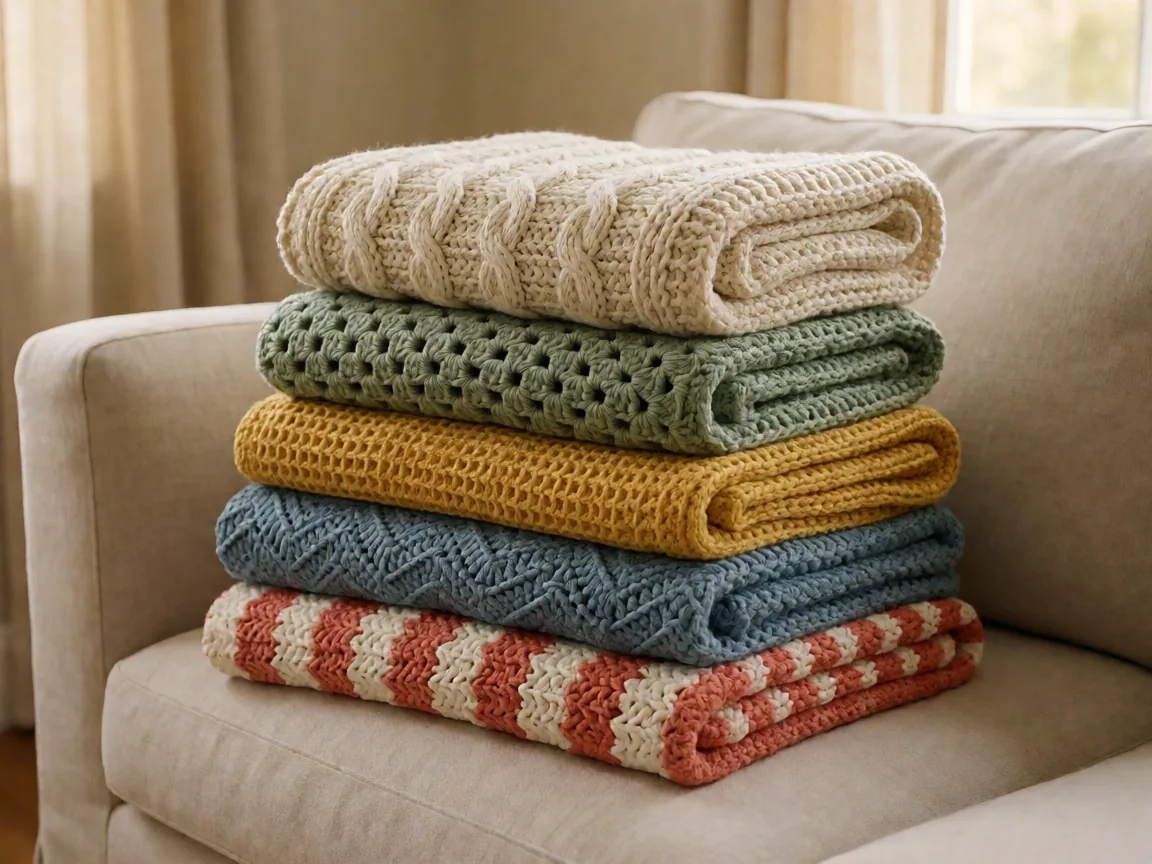
Every crochet beginner eventually wants a blanket, and most of them start one too early. A blanket is the largest single project in this entire hobby. A baby blanket is around 1,200 stitches. A single-bed blanket can be 60,000. Both feel identical in the first hour and completely different in the twelfth.
So this roundup is sorted by construction, not by trend. “Cute” is a matter of taste and it tells you nothing about whether you will finish. Construction tells you exactly what skills the project demands and roughly how long it will take, which is the only information that matters on day one.
Before you commit yarn: check your gauge. A blanket is the one project where being two stitches off per row compounds into a finished size that is nothing like the pattern’s. And pick your yarn using yarn weight rather than colour — weight decides the outcome.
Why blankets are harder than they look
Three things make blankets harder than a dish cloth, and none of them are about stitch technique:
- Scale. A tension wobble you would never notice on a dish cloth becomes a visible ripple across six feet of fabric.
- Boredom. A blanket row is a wall of identical stitches. Your attention will wander and your stitch size will change.
- Washing. The finished object goes in a machine. Yarn that felts, thins, or loses drape ruins the work in one cycle.
Every pattern below is chosen to avoid at least one of those. If a project makes you miserable on day nine, that is information, not weakness — put it down.
The 12 patterns
1. Two-Square Baby Blanket — the smallest commitment
Construction: two granny squares, seamed together.
Yarn: DK cotton, approx. 400m / 430yd.
Finished size: 60 × 75 cm (24 × 30 in).
Time: 8–10 hours over 3 evenings.
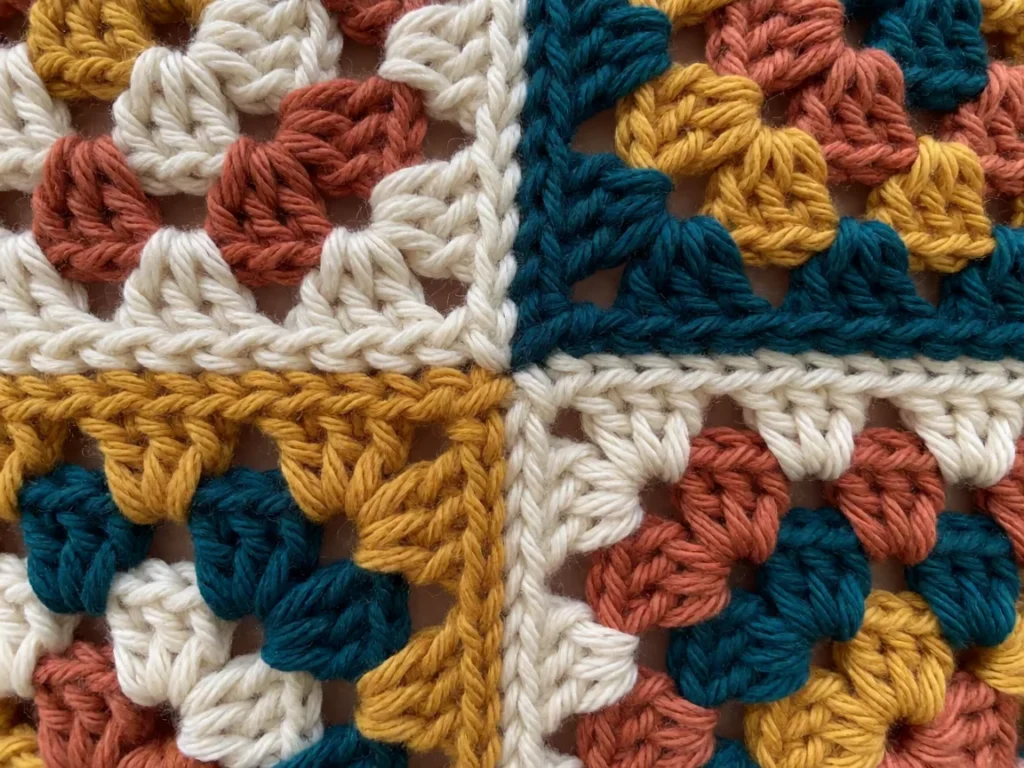
Two squares, joined. That is the entire pattern, and it is enough to teach joining, borders and blocking. It is also the shortest possible route to a blanket you can actually use or gift. Start here.
2. Four-Square Granny Blanket — the classic
Construction: four squares, seamed, with a simple border.
Yarn: DK worsted, approx. 700m / 750yd.
Finished size: 85 × 110 cm (33 × 43 in).
Time: 15–18 hours over a week.
The blanket everyone pictures, and it is genuinely a good first blanket. Four identical squares means you make the same thing four times, so your tension improves as you go and the later squares will be better than the first. Visible seams are part of the look.
3. Single Crochet Row Blanket — pure flat fabric
Construction: one piece, worked in straight rows.
Yarn: Worsted weight, approx. 900m / 980yd.
Finished size: 100 × 130 cm (39 × 51 in).
Time: 18–22 hours.
No seams, no motifs, no shaping. One stitch type for the entire project. If your worry about blankets is that you cannot find your way around them, this removes the problem entirely — a rectangle is always a rectangle, however long it gets.
4. Single Crochet Round Blanket — one stitch, worked in the round
Construction: one piece, continuous spirals, joined at the end.
Yarn: DK worsted, approx. 800m / 875yd.
Finished size: 110 cm (43 in) circle.
Time: 20–24 hours.
A round blanket has no straight edge, which is why it drapes so well and why it cannot be turned wrong-side-out halfway. Spiral joins mean no joining work. The trade-off is that you cannot easily pause and put it down mid-round, so set aside an evening rather than an hour.
5. Double Crochet Lap Blanket — fastest to make
Construction: one piece in rows, worked in double crochet.
Yarn: Aran weight, approx. 800m / 875yd.
Finished size: 100 × 150 cm (39 × 59 in).
Time: 10–12 hours.
Double crochet is three times the height of single crochet, so the same fabric arrives in a third of the rows. This is the fastest substantial blanket here. It is also the least dense and the least warm, which is a reasonable trade for a lap throw.
6. Moss Stitch Throw — texture, not pattern
Construction: one piece in rows, single crochet and chain alternating.
Yarn: Aran weight, approx. 900m / 980yd.
Finished size: 120 × 150 cm (47 × 59 in).
Time: 16–20 hours.
Moss stitch is a two-row repeat: a row of single crochet, then a row of chains. Visually it produces a pebbled texture that hides tension variation better than any flat stitch. If you are worried about visible ridges, this is the pattern that forgives most.
7. Chevron Baby Blanket — colourwork, flat
Construction: one piece in rows, two colours per row.
Yarn: DK cotton, approx. 600m / 655yd.
Finished size: 75 × 90 cm (30 × 35 in).
Time: 14–16 hours.
Chevrons are a two-stitch pattern that produces a strong zigzag. The colour changes at the end of each row are the only added mechanic. It looks considerably more advanced than it is, which is exactly why it makes a good confidence project.
8. Granny Stripe Blanket — rounds plus joins
Construction: rectangular granny stripes, worked in rounds then seamed.
Yarn: Aran weight, approx. 1,100m / 1,200yd.
Finished size: 130 × 170 cm (51 × 67 in).
Time: 28–34 hours over 2 weeks.
Long coloured stripes joined in pairs, then joined again. It asks for real stamina and produces a full-size throw. This is where you find out whether you actually enjoy long projects — worth knowing before you buy a metre of every colour in the shop.
9. Filet Crochet Blanket — the biggest commitment
Construction: one piece in rows, double crochet and chain mesh.
Yarn: Sport weight cotton, approx. 1,400m / 1,530yd.
Finished size: 130 × 170 cm (51 × 67 in).
Time: 40–50 hours over 3 weeks.
Filet is a mesh of chains and double crochet, so it is fast per row but there are an enormous number of rows. It is the lightest and most breathable blanket here, and the most portable — many people work a lap version instead. Do not attempt this before you have finished one item from the beginner roundup without frustration.
10. Houndstooth Blanket — technical colourwork
Construction: one piece in rows, two colours carried across rows.
Yarn: Worsted weight, approx. 1,000m / 1,090yd.
Finished size: 120 × 150 cm (47 × 59 in).
Time: 35–45 hours.
Houndstooth is a four-row colour sequence, which sounds simple until you have to carry two colours across a 150 cm row. It is genuinely one of the harder colourwork patterns and the result is unmistakably professional. Attempt it after two other colourwork pieces.
11. Afghan Stitch Throw — clusters, texture, speed
Construction: one piece in rows, three stitches worked as a cluster.
Yarn: Bulky weight, approx. 600m / 655yd.
Finished size: 110 × 150 cm (43 × 59 in).
Time: 8–10 hours.
Afghan stitch groups three stitches into a textured cluster, so it covers a lot of ground very quickly. It is the shortest route to a full-size throw here, at the cost of using up yarn fast. A good confidence project if single crochet rows are already comfortable.
12. Waffle Stitch Blanket — the one you should grow into
Construction: one piece in rows, post stitches around front and back posts.
Yarn: Aran weight, approx. 1,000m / 1,090yd.
Finished size: 130 × 170 cm (51 × 67 in).
Time: 30–36 hours over 2 weeks.
Waffle stitch works stitches around posts rather than into tops, creating deep pockets. It is thick, warm and structurally interesting. It is also the most demanding technique on this page, and the pattern most worth growing towards over a season rather than starting on a Saturday.
Which one should you actually make?
| If you have | Make |
|---|---|
| Never finished a blanket | 1 or 2 |
| Tension drifts after 20 rows | 3 or 6 |
| Want the fastest full-size throw | 5 or 11 |
| Want something to gift this month | 1 or 7 |
| Have done colourwork before | 7 or 10 |
| Want a project for a whole month | 8, 9 or 12 |
Before you buy yarn
Three checks, in this order:
- Buy the weight class, not the brand. If the pattern says DK, any DK yarn works. If the pattern names a specific yarn, treat it as a suggestion unless it says “substitute with”.
- Buy one extra ball. Dye lots vary, and a ball from a different lot in the middle of a blanket is visible. A spare ball also protects you from the discovery that you were 30 metres short.
- Wash a swatch first. Ten minutes in a washing machine tells you whether the blanket survives being washed. Some of the most beautiful yarn in this hobby felts.
Our guide to choosing yarn for crochet covers what each weight class does to gauge and drape, and how to substitute safely.
Frequently asked questions
Which yarn weight makes the easiest first blanket?
Light or light worsted. A fine yarn shows every mistake you make, which sounds discouraging but is exactly what makes it forgiving — the stitch pattern disguises tension that a chunky yarn turns into visible wobble. Working in a heavier yarn, the fabric hides errors until the final row, which is the least useful time to find them.
How much yarn should I buy?
Take the pattern’s stated yardage and add ten per cent. Dye lots vary between batches, and a stripe that came from a different skein is visible across a large flat piece. The extra also covers the swatch you should be making first.
Can I use a different yarn at the same weight?
Usually yes for a single weight, never across fibre on something fitted. Same weight and a similar construction behaves predictably; different fibre does not, which is why wool and cotton do not substitute for each other on a garment. When you do substitute, swatch it and re-check your gauge before committing to the whole panel.
Weight classes referenced across these patterns use the Craft Yarn Council standard yarn weight system, so a band labelled “medium” means the same density wherever you buy it.
Choosing between two yarns and unsure which suits the project? Leave a comment with the pattern and the two weights — I will tell you which one to buy.