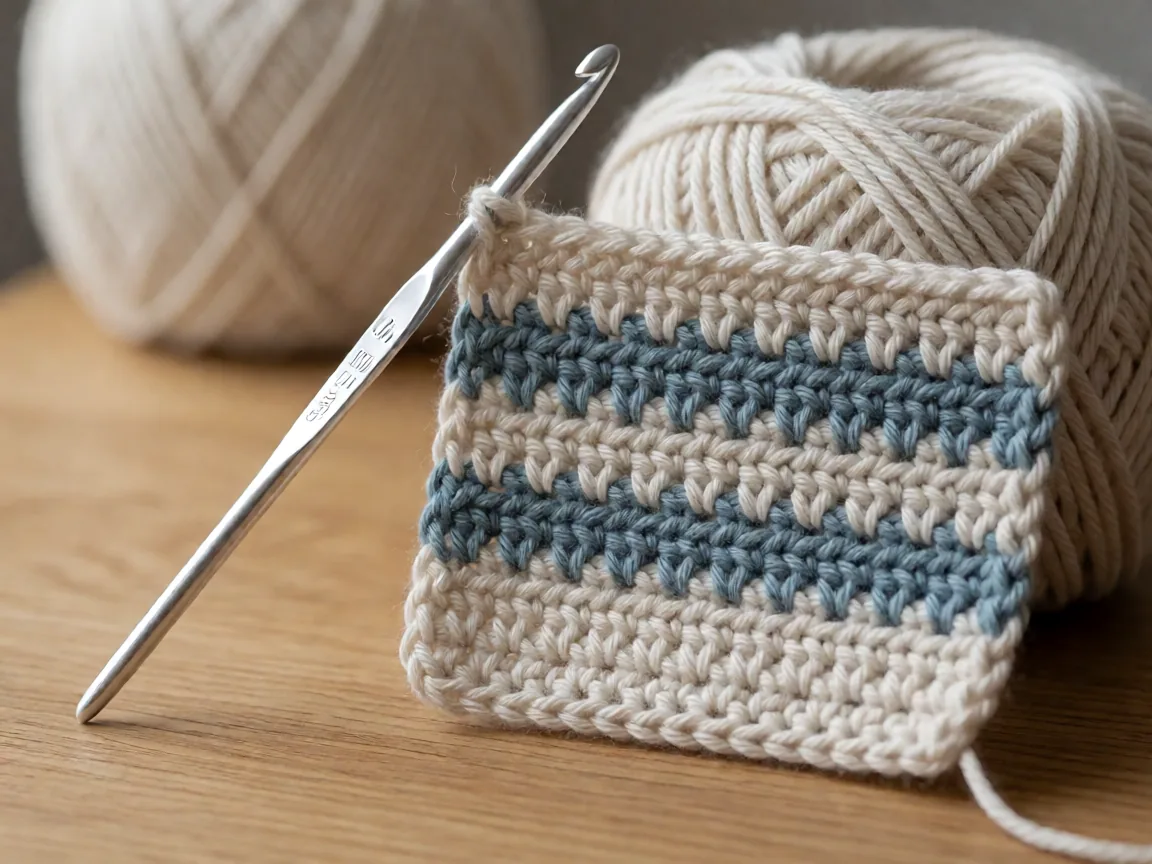
The reason most people never finish a crochet project is not effort. It is that they start something too ambitious for the four stitches they can already work. A first blanket fails for the same reason a first crossword fails when you start with the Sunday edition: you skipped the easy part.
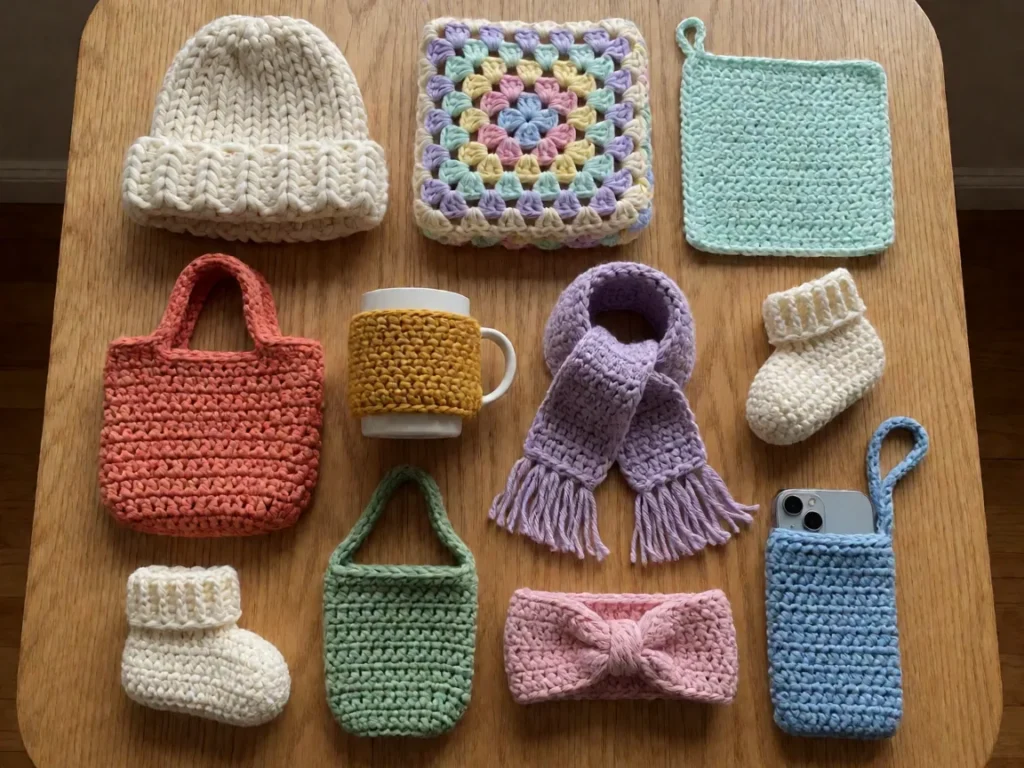
Below are ten patterns to hand to a total beginner in this order. They are sorted by stitch count rather than by how cute they look, because stitch count is the only honest measure of difficulty available before you start. Every pattern below states its yarn weight, its stitch vocabulary, and roughly how long each one typically takes. If you can work a chain and a single crochet, you can finish at least the first five.
Before you reach for the list, make sure you are comfortable with the mechanics in Crochet Stitch Meanings — specifically single crochet, since it does most of the work in this roundup. If terms like sc2tog make you close the tab, start with How to Read a Crochet Pattern instead and come back.
What beginners can actually make
Here is the honest capability ladder for a crocheter who can chain, work single crochet, and count their own stitches:
- Flat fabric — anything worked in rows: dish cloths, bags, cushions.
- Shaped decreases — anything that narrows: hats, cup cozies, beanies.
- Small 3D shapes — amigurumi, once you can decrease and close a piece.
- Joined motifs — granny squares, once you can sew or join as you go.
- Garments — sweaters, only once you have made three of the above.
Every pattern on this list lives in the first four rows. None of them require you to knit, follow a chart, or trust a designer.
How to pick your first pattern
Three questions, in order:
- How many stitch types does it use? Count the abbreviations in the pattern body. Under five is a comfortable first project. Over ten means you will be stopping to look things up every row.
- How many hours does it realistically take? Flat projects in cotton are fast. Shaped 3D pieces are slow because of finishing, not stitching.
- Do you want to see progress? Round and shaped pieces show you how they look every row. A flat rectangle stays a flat rectangle until the very end.
And check the yarn weight before anything else. Patterns specify a weight class, not a brand. Our guide to choosing yarn for crochet explains what the weight numbers actually mean and what happens if you substitute a different one.
The 10 patterns
1. Puffy Coin Purse — chain only
Stitch vocabulary: chain, slip stitch.
Yarn: DK cotton or acrylic.
Time: 45–60 minutes.
This is a chain stitch and a slip stitch. That is genuinely the whole list. It is also the fastest confidence-builder in crochet because you cannot go wrong in a way you cannot see — the errors show up immediately as a twist.
Make it because it teaches you to read your own work back to yourself. Read the slip stitch guide first.
2. Simple Cotton Dish Cloth — chain and single crochet
Stitch vocabulary: chain, single crochet.
Yarn: Worsted weight cotton.
Time: 60–90 minutes.
The traditional first project, and it earns the slot. It is flat, it is fast, and it uses the one stitch you will use for the rest of your life. The only slightly awkward part is the turning chain at the end of each row — which is just a chain, so it reinforces what you already know.
Make it because it produces something useful. Useful projects get finished.
3. Striped Beanie in Single Crochet — with decreases
Stitch vocabulary: chain, single crochet, single crochet decrease.
Yarn: Worsted weight wool blend.
Time: 3–4 hours.
This is the first pattern that teaches you to make something smaller, which is the concept beginners resist most. A decrease is two stitches becoming one. Once that clicks, hat shaping stops being magic.
Make it because it is the first project where the shape comes from the stitches rather than from the geometry.
4. Basic Granny Square — joins
Stitch vocabulary: chain, double crochet, chain.
Yarn: Any weight, worsted is easiest.
Time: 2–3 hours for one square.
Two stitches, but a new skill: the join. You will learn to fasten off cleanly and re-attach, and that skill is required for almost everything you will ever make.
Make it because granny squares are the gateway to blankets. Our crochet blanket roundup assumes you can make one of these.
5. Two-Hour Bunny Plush — first 3D piece
Stitch vocabulary: chain, single crochet, single crochet decrease, single crochet increase.
Yarn: DK or sport acrylic.
Time: 2–3 hours including assembly.
Your first piece that closes. You will learn increases (one stitch becoming two), which is the inverse of what you learned on the beanie, and you will learn to stuff evenly.
Make it because it is the project that makes crochet click. Everyone remembers their first finished toy. Our amigurumi roundup is the natural next stop.
6. Flat Cotton Tote Bag — flat with a handle
Stitch vocabulary: chain, single crochet, double crochet.
Yarn: Worsted weight cotton.
Time: 4–5 hours.
Flat construction with a strap. Once you have made one, you can make a market bag, a library bag, or a book tote by changing the dimensions. This is the highest-value flat pattern on the list for repeat use.
7. Spiral Scrunchie — first pattern with a working instruction
Stitch vocabulary: chain, single crochet, single crochet decrease.
Yarn: Lace or sport weight elastic-friendly yarn.
Time: 60–75 minutes.
A scrunchie is worked in a continuous spiral with stitch markers. It introduces a genuinely new skill: counting rounds, and noticing that you must decrease to keep the spiral flat rather than drifting outward.
Make it because it is short enough to abandon guilt-free and teaches round construction.
8. Square Cushion Cover — double crochet and seaming
Stitch vocabulary: chain, double crochet, single crochet border.
Yarn: Aran or bulky cotton.
Time: 4–6 hours.
Flat, quick, and it teaches a border. A tidy border is the difference between a handmade cushion that looks deliberate and one that looks abandoned. Once you can border, you can finish anything.
9. Ribbed Cup Cozy — back-loop only
Stitch vocabulary: chain, single crochet in back loop only.
Yarn: Aran weight cotton.
Time: 90 minutes.
A cup cozy is small, useful, and it introduces back loop only — a texture variation on a stitch you already know. Ribbing looks like a different stitch entirely until you understand it is just single crochet worked into one loop.
Make it because it is the fastest satisfying object on this list.
10. Round Floor Cushion — worked in the round
Stitch vocabulary: chain, double crochet, half double crochet, single crochet decrease.
Yarn: Bulky weight.
Time: 6–8 hours.
The most ambitious thing on this list, and still a beginner project. It is worked in continuous rounds, increases for the disc, then decreases to raise the sides. That is three techniques, each of which you have now met separately.
Make it last, once you have finished at least three others. It is also the pattern people most often get wrong on the first attempt, and that is fine.
How to move from these to real skill
Make two or three of the above before you touch anything else. Repetition is where tension actually becomes consistent — not reading about it. Once your single crochet rows are even without counting twice, move on to double crochet, which triples your row height and changes how everything feels.
Two habits worth building from day one. Measure your gauge before starting anything that claims a finished size — it is the least enjoyable step that saves you the most. And read the whole pattern before row one, using our pattern-reading walkthrough, because patterns almost never contradict themselves once you have read ahead.
Once you have finished something, the roundup that usually comes next is amigurumi patterns — smaller, faster, and the fastest way to build a collection of finished objects.
Frequently asked questions
How do I tell whether a pattern is genuinely beginner-friendly?
Read the abbreviations list before anything else. If it contains nothing beyond chain, single crochet, double crochet and slip stitch, it will teach you something. If it opens with terms like sc3tog, blo or a chart symbol, put it back — not because it is bad, but because you will spend the whole project reading.
What if my finished piece comes out the wrong size?
Almost always tension, and always measurable in advance. Check the stated gauge before row one, then measure a 10 cm swatch in the actual yarn with the stated hook size. If your count does not match, change the hook before you change anything else. Our gauge guide covers the arithmetic for recalculating a finished size.
Should I learn a whole new technique for every project?
No. Pick two or three projects that share the same stitches and get all three finished. Skills compound when they are applied repeatedly, not when they are collected — a single ambitious pattern that stalls teaches you less than three simple ones you complete.
Yarn weights quoted in these patterns follow the Craft Yarn Council standard yarn weight system, so the weight class on a ball band means the same thing here as it does in the shop.
Working through your first one and stuck on something specific? Leave a comment and tell me which pattern and which step — that is the fastest way to get a usable answer.